Paperwork in. Verified data out.
Thresh reads filled forms, contracts, and scanned packets and returns the names, dates, amounts, checkboxes, and tables that matter, each one linked to the exact spot on the page it came from. No re-typing, no page-flipping.
- purchase_price385,000.00 · p.1
- closing_dateSeptember 18, 2026 · p.2
- financingConventional · p.2
Accuracy measured on 37 filled documents (five complete real-estate transaction packets plus scanned and handwritten paperwork) with verified ground truth, July 2026. How we measure.
Try it on a real document
Pick a sample from the benchmark corpus. Everything you see is a real extraction the production API already ran, replayed in your browser: click a field and it lights up the exact spot on the page it came from. Nothing is uploaded and no model is called.
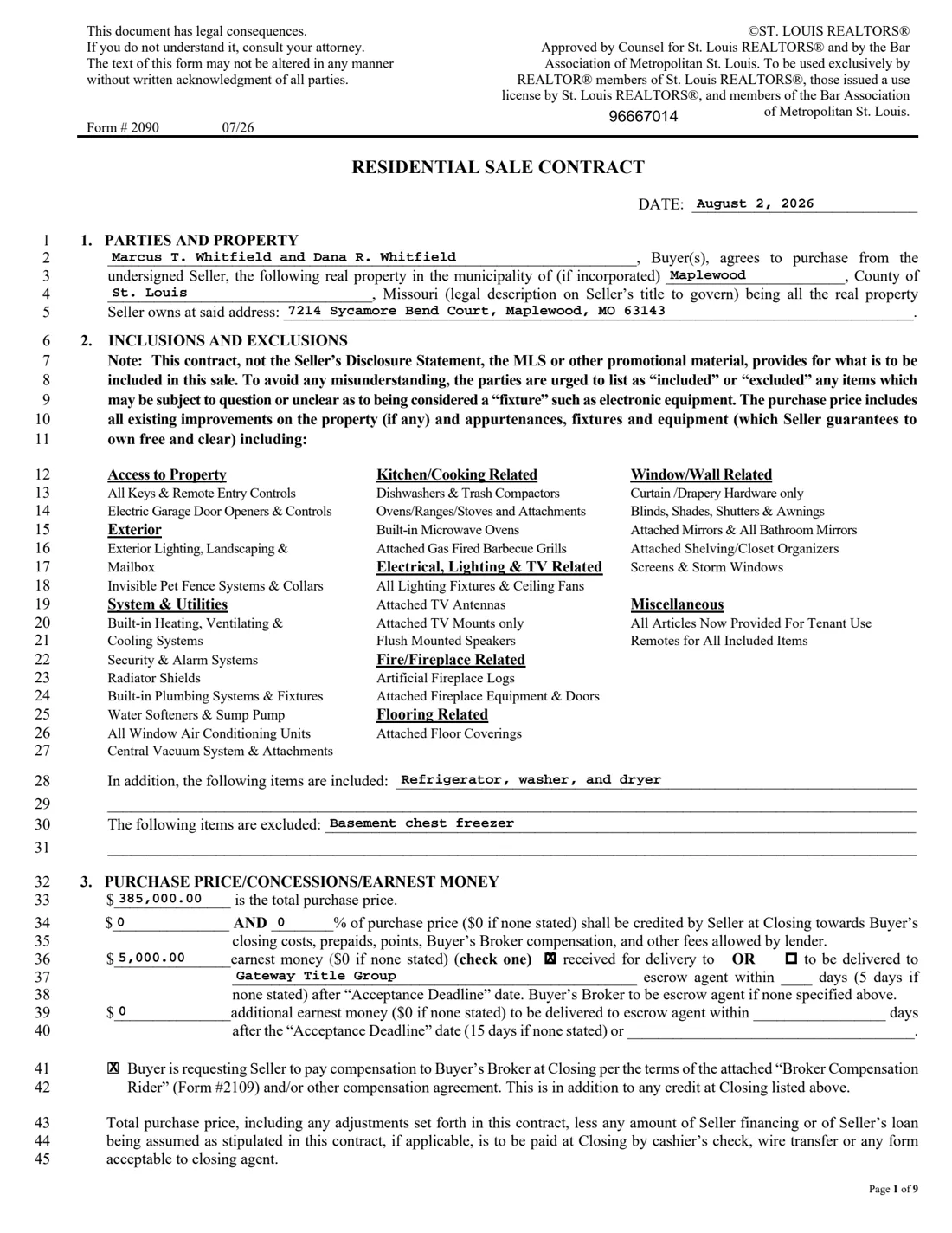
11 FIELDS EXTRACTED · RUN c9600a50 ON THE PRODUCTION API
The workspace adds the whole Whitfield deal and the synthesis replay.
How it works
- STEP 01Upload your documents
Pick the saved template and drag in a file or a whole packet. PDFs, scans, and handwriting all work.
- STEP 02We pull out what matters
Names, dates, amounts, checkboxes, and tables come back as organized data. Every value is linked to the page it came from, and anything uncertain is flagged instead of guessed.
- STEP 03Check it, then move on
Review mode shows each value beside the highlighted spot on the original document. Accept or fix in one click, and results flow into the system your team already uses.
The whole transaction, checked against itself
Real documents travel in packets: a contract, its riders, disclosures, notices. Group them into a deal and Thresh synthesizes one deal object across all of them: parties, financials, key dates, a role for every document, and the riders the contract references cross-checked against what's actually in the packet.
- Discrepancies surfaced with severity: a credit amount that contradicts the contract, a date that's impossible given another, a referenced rider missing from the packet.
- Built to stay quiet on clean packets. On live validation it flagged only genuine conflicts, including a mistyped credit and a mangled ZIP code, with zero false positives.
- A full seven-document packet synthesizes in about two minutes, from the documents' extracted data, with no re-reading of pages.
- No developer needed day to day: members pick the saved template, upload the packet, and read the synthesized deal in the console.
The real product against the live API: sign in, create a deal, upload a packet, synthesize. Recorded from the production console; the synthesis wait is trimmed.
It ends in your system of record
Your documents don't live in Thresh; they live in your CRM, your ERP, your claims system. Signed webhooks deliver every extraction to your endpoint the moment it completes, so results land where your team already works. Here's our Salesforce worked example: a contract attached to an Opportunity comes back as native field records, from roughly 150 lines of reference code. The Follow Up Boss example and the rest are on the integrations page.
Recorded against a real Salesforce Developer org and the live API: register the webhook, attach the document, and the extracted fields arrive as records with page and confidence. Not a managed package; it's reference code an integration team adapts in an afternoon. Ask for the reference integration.
Building the integration yourself?
Thresh is an API underneath: define a schema, upload a document, get conforming JSON back with signed webhooks. The quickstart, SDKs, and the timed zero-to-integration run live on the developer page.
Built for the paperwork you actually have
Real estate brokerages
Transaction packets into verified data: contracts, riders, disclosures, and inspection notices, with deal grouping and cross-document discrepancy checks.
Read morePhysician contracts
Compensation, wRVU terms, tail coverage, and restrictive covenants pulled from employment agreements, each value linked to its source clause.
Read moreReplacing an OCR pipeline
Why text-first extraction loses tables, checkboxes, and provenance, and what schema-first extraction does differently. Honest about when OCR still wins.
Read morePricing
- 100 pages a month
- The whole product, no card
- Hard cap, community support
- 1,000 pages included
- Then $0.05 a page
- Email support
- 7,500 pages included
- Then $0.04 a page
- Priority support
- Volume pricing
- Deployment and compliance options
- Tailored to your documents
Every plan includes fields, tables, Q&A, deal synthesis, webhooks, and the console. Deal synthesis counts one page per document in the deal (minimum 3). Failed extractions are never billed. Thresh is currently invite-only: request an invite and we'll set you up. Design partnerships are free.
Built for documents you can't send just anywhere
- Tenant isolation at the database layer
Row-level security enforced by the database itself, not application code.
- Encrypted in transit and at rest
TLS everywhere; documents encrypted in storage.
- Zero-retention model calls
Extraction runs inside our cloud boundary; pages are not retained for training.
- Append-only audit trail
Every upload, extraction, key event, and webhook delivery is logged.
Architecture built from day one toward SOC 2 and HIPAA readiness (not yet audited).
Design partners: bring us your worst documents
We're taking on a small number of design partners. Send ten of your real documents, the ones your current process gets wrong, and within a week you'll get back verified results, a per-document accuracy report, and a working integration. Free during the partnership; you help shape the roadmap.
support@usethresh.com